Showing posts sorted by relevance for query "first steps". Sort by date Show all posts

Tuesday, February 08, 2005

Missouri First Steps

I have called the governor, my state representative, and my state senator. I am going to the capitol tomorrow for a public hearing, at which I hope to speak. I am sending ahead a picture of my "child who has been helped by the First Steps program" since I will miss most of the pre-hearing press conference. I have emailed the governor and my legislators, with a copy sent to each of the appropriate committee members. Here is the letter that I'm sending (along with a picture of Ellie) to my elected representatives:

February 8, 2004

Governor Matt Blunt
P.O. Box 809-A
Jefferson City MO 65102

Governor Blunt:

I'm sure that you've read all about how $1 spent on early childhood intervention saves more than $7 down the line. I'm sure you know that the First Steps program helps prepare children for entry into the public school system. Rather than talk about the economics and politics of the First Steps program, I'd like to tell you how First Steps affects my family.

I am 30 years old and my daughter, Eleanor, is 15 months old. She has Down syndrome. 40 years ago, children with Down syndrome were routinely institutionalized. It was thought that they could not learn.

Ellie has been receiving therapy through the Missouri First Steps program since she was 3 months old. At this point, she is tracking very close to developmental norms for her age group. At 15 months, she has 10 words (and understands many more). If I show her a picture of our church and ask her to point at the tree, she will point at the tree. If I hand her a shape, she can place it through the correct hole in the shape sorter. She crawls. She can feed herself. She helps to get herself dressed every morning. She is a loving, sweet, wonderful child and a greater blessing to our family than we could ever have imagined.

Ellie's successes come in part from her exceptional nature, but a lot of the credit goes to her wonderful First Steps therapists. Currently she sees a physical therapist, an occupational therapist, a developmental therapist, and a speech therapist. They tell me that keeping Ellie "as close to developmental norms as possible" is a realistic goal. They tell me that she should be able to be in a typical classroom at school in a few years.

The First Steps program has had an immeasurable effect on my family. Please do not cut funding for this program.

Sincerely,
Ellie's family

cc:
Representative Richard Byrd
Senator Michael Gibbons

Thursday, February 10, 2005

Ellie the Lobbyist

I wish I'd taken a camera to document the occasion. Someday, I'm sure Ellie will be proud to say that she protested at the Capitol before she could even walk! She did wonderfully during the 3 hour hearing. She was wired and stayed up until 11:30 last night, then slept in until 8:30 this morning!

Thanks to Save First Steps, we knew exactly when the public hearing was, where to park, and how to get to the meeting room. We noted on the map that the hearing was in the largest meeting room. Nonetheless, when we arrived we found the hallways outside the room crowded with parents, advocates, providers, and children. It was chaos and pandemonium. When we finally got close enough to see inside the hearing room, Paul counted close to 200 people inside.

After waiting in the hall for over an hour, we managed to squeeze in, and we could finally hear. I wasn't called to testify, but I did have a picture of Ellie alongside a paragraph describing how well she's doing because of First Steps that I submitted to have passed out to the committee. I only wish I'd had time to schedule meetings with my state senator and representative while we were in town.

The testimonies were fascinating. It turns out that the governor and the committee believe that private insurance would pay for the services that First Steps provide and that Medicaid will pick up the rest of the tab. Um, no. Most private insurances only pay for rehabilitative therapies, e.g. short term accident-recovery scenarios. They won't pay for developmental therapies, therapies related to a congenital condition, or anything at all once you've reached your lifetime cap. Many of these kids reached their lifetime cap shortly after they were born, due to special medical issues. And most of us who benefit from First Steps don't qualify for Medicaid. (Who really does, anymore? Blunt cut that program too.)

We heard testimony about how hard it is on families to have a child with special needs. Man, that's true. The divorce rate is sky high. The one thing that has been easy about dealing with Ellie's "special needs" has been accessing the First Steps system. Before she was even born, we were told about the system. Before we could take Ellie out into the world, an intake coordinator came to our house to explain First Steps to me. As soon as I was emotionally able to pick up the phone and call, therapists started coming to our house. I cannot quantify how much this program has helped me emotionally. It's incredibly powerful to have these trained professionals looking out for your child and teaching you what to do when you don't even know how to begin. I think everyone should have a few visits from a pediatric PT and OT when they bring a new baby home. It's amazing.

Thanks to all who have been so supportive. I don't know if Missouri First Steps will be saved, but I feel like I'm doing everything I can to help save the program. So far, all the Democrats are telling me that the program is critical and must be saved. The Republicans are telling me that the cuts have to come from somewhere to hold the line on taxes. I guess it's easiest to cut the money here. What's easier than taking candy from a baby with disabilities?

Monday, February 28, 2005

First Steps Update

Blunt supports reformed First Steps program
BETSY TAYLOR
Associated Press
ST. LOUIS - Gov. Matt Blunt outlined a proposal Monday that would largely keep intact the First Steps program for developmentally disabled children but would require families and insurance companies to pick up more of the tab. . . .

Blunt planned to keep the First Steps name, but supports legislative changes requiring participating families to pay a fee on a sliding scale, with the highest costing $100 per month.

We can afford this. If the system ends up working exactly the same as it currently does, but with those of us who can afford it paying $100/month, I will be OK with the changes. (The first news reports called for $100/session, and Ellie has 4-7 sessions a week so the cost for us would have been astronomical.)

One concern I have is the private insurance part. I hope that I don't end up having to spend hours each month fighting with our insurance company to pay for therapy services and equipment needs. Under the current First Steps program, the therapists and I talk about what Ellie needs, then we request it from her case manager who gives us the thumbs up or thumbs down. It's a very efficient system. I don't want insurance companies - rather than a case manager who's involved with Ellie's care - deciding when it's acceptable for her to receive the care she needs.

The real bummer? Blunt says that funding will come from "money saved by changes in Medicaid." This is a real mixed blessing. I am so glad that Ellie and other young children with special needs are getting the services they need. I am very sad that these services are being funded at the expense of Missouri's neediest families. My senator is sponsoring the legislation.

Short related rant. Why does Governor Blunt now insist that he never meant to cut the program, when he so obviously did cut the program? What's so wrong with admitting that you made a mistake, that you misunderstood what the program was about? All this stress for $2 million dollars: a fraction of a percent of the state's budget.

Sunday, February 27, 2005

Democracy in action

.
These passages were cut from a couple of emails I received recently from Appropriation-Education Committee members. The bolded emphasis is mine.

I wanted to let you know I appreciate your concern regarding the Governor’s proposed elimination of the First Steps program and to give you an update. The Governor’s cut was addressed in public testimony last week before the House Appropriations Committee on Elementary and Secondary Education. The public turnout for the hearing was impressive and the testimony was extremely moving. I commend the people who came and shared their heartfelt stories. As an educator I fully understand the positive consequences of early intervention, home therapies, multi-disciplined approach, just some of the benefits, as you know, of First Steps.

The committee did not approve the Governor’s move to eliminate First Steps. The committee members voted the budget out with First Steps still in it. Keep in mind that passing the budget bills is a process that takes many weeks. Final closure comes with the Governor signing or vetoing the budget bills later in the session. The Governor can choose to change his recommendation to cut First Steps at any time.


Rep. Sara Lampe - Democrat
District 138, Springfield

From the beginning, members of this committee as well as many in the Capitol have backed the services of this program. Details of the program are not available but the dialogue and planning is firm enough that I have received word that a letter of recommendation for funding could be included in my 3/1/05 report to the Budget Committee and that dollars outside our responsibility would fund it.

On Tuesday, February 22, the Committee voted unanimously for the Chair/me to send a letter on their behalf. I expect the Budget Committee to also offer strong support and accept the recommendation and funding source. The appropriation/budget process is working, but is not completed.


Kathlyn Fares (Webster, Missouri - Republican)
Appropriation-Education Chair

When the representative democracy works, it is a beautiful thing. In this case, it's not working perfectly. The $1 million approved is far short of the $20+ million the program currently costs, even when the $8 million that the federal government is willing to chip in is added on. At least legislators now know that this program is important and that there will be an outcry and political ramifications if it is eliminated. I am beginning to feel very worried that it won't be fully funded, though. We are lucky that we will be able to afford the therapy that Ellie needs. But I really think that our whole family is benefiting from my working only part time right now and I do not want to have to go back to a full time job plus travel schedule this year.

Thursday, February 03, 2005

Missouri First Steps - Draft 1

Matt Blunt is a poopyhead.

I've been spending a lot of time with toddlers, you see. And it's hard not to take this attack personally. I'm working on a somewhat more nuanced discussion of my feelings on this issue, which I can send to new Governor Blunt and to my Missouri legislators. (Blunt's first budget, effective August 2005, zeros out funding for the Missouri First Steps program.)

Matt Blunt, who is only a couple of years older than me, is expecting his first child, a son, in March. God willing, the little boy will be healthy. He won't come too early or too late, he won't experience trauma during the birthing process, he won't be harmed by any of the drugs used on his mother, he will be healthy and smart and will develop typically. If his son has any problems at all, Blunt's insurance will cover only limited therapy visits and he would have to private pay for therapy at $50-75/hour and take his child to a center rather than having therapists make home visits.

When you have a newborn who shouldn't be exposed to other kids because of a health condition, these home visits are particularly important. It's also hard to imagine visiting a center for the 5 therapy appointments a week that my daughter sometimes has. You can't stack the appointments up one right after another - too exhausting! So that's several different trips to a therapy center every week. How will parents find the time? Surely they're all working at least one job to pay for all this therapy.

See? Poopyhead.

Friday, May 02, 2008

A Culture of Life?

I knew that I was expecting a baby with Down syndrome, and the news got around. Pretty soon, I started getting recommendations. A coworker I barely knew has a son with the same diagnoses Ellie has, and she stopped by my office with a lot of great information (and support) including the name of her son's fabulous pediatrician and his inclusive daycare, complete with great therapists. The special OB who performed my prenatal testing set me up with a terrific pediatric cardiologist who did a couple of fetal echocardiograms. Fetal. Like, before Ellie was even born. And then I had 20 weeks to grieve for what I imagined I'd lost, and to prepare for my daughter's birth.

When Ellie was born, I was so far ahead of where most women are after giving birth to a baby with trisomy 21.

And I loved my baby. I loved her so much, I hardly ever put her down. We had no problems nursing; we had immediate, intense attachment. Also, my mom had given me a book of therapy exercises to do with young children with Down syndrome, which I did daily almost from the time we got home from the hospital.

But I was still paralyzed by fear and discomfort and desire not to have to negotiate this new world into which I was thrust. I could handle the medical stuff. But First Steps and therapies? Nonononononono.

Many pediatricians deal mostly with typically developing children, but Ellie's amazing, wonderful, terrific, unbelievable pediatrician was so helpful. She made the first call for me. She followed up. She told me what to expect, what to ask for, what Ellie needed. I got it all.

And then, the system changed. After our new "Pro-Life" governor was convinced that he really didn't want to eliminate the First Steps program after all (start at the bottom) he still decided to cut it way back.

He instituted fees for some of the services, and a whole new model for determining what services are provided to our state's most vulnerable children.

When Ellie was 4 months old, she had an OT and a PT. By the time she was 12 months old, she'd added a developmental therapist and a speech path. A woman I know had a baby with Down syndrome two years after Ellie was born, and by the time her baby was 9 months old, she was receiving zero services. Nothing. Nada.

Because now, instead of working with the parent to determine the baby's needs based on diagnosis, pediatrician's recommendation, evaluation, or even a simple questionnaire, it's all based on one question: what are your concerns?

When the stunned new parent of a baby with any sort of special need finally works up the nerve to call the organization that's supposed to help her child, she's presented with this:

How are things going; do you have any current concerns?

It's a newborn baby! With an unexpected diagnosis! What is the parent supposed to say to this?! She's not walking properly yet, being a newborn and all. Perhaps she should have physical therapy?

As the parent, I am the expert on my baby. I'm the expert on her day-to-day needs, and on loving her. BUT, I'm not an expert on all babies. I'm not an expert on PT, OT, development, medicine, or speech. I need to be able to rely on a team of experts who will tell me what my baby needs.

But we withhold this information, tying the hands of the providers lest they offer more services than the parent knows to ask for, costing the state money (in the short term). Yet we want women to choose not to have abortions?

No Child Left Behind has made sure that public education continues this ugly trend.

The goals on a student's IEP (individualized educational plan) drive what therapies she receives and what her therapists address with her. But the goals are derived directly from the "Family Concerns" section of the IEP. We messed up last year and didn't write down enough parent concerns and are currently having to supplement Ellie's therapies in all areas.

Tomorrow is Ellie's IEP meeting for next year, and I've been preparing for weeks. I've taken a training class and I have a better idea of what to ask for, and how.

But it shouldn't be this hard for parents. The experts should be able to help us determine what Ellie needs, and what it's realistic to ask of her.

Because, you know what? I'm more equipped to deal with this situation than a lot of other parents. What does it mean for their children? And what does it mean for our society when these children leave school and are expected to become productive adults?

Tuesday, June 14, 2005

Down Syndrome Help

An online friend recently asked me about resources for a co-worker who's the parent of a baby newly diagnosed with Down syndrome. I thought it might be helpful for me to copy my response here, in case anyone else ever has need of it:

My heart goes out to your friend. I know what I felt in her position and I wouldn't wish it upon my worst enemy.

That said, some people get very angry with sympathy. Some people seem to immediately accept their child's Down syndrome and don't want to hear "I am so sorry," from anyone.

When looking for helpful reference books, I'd recommend looking only at recent publications. Older things (1980's and before) are often incorrect, offensive, and as depressing as hell.

Anything published by Woodbine House is probably a great bet, especially this book: Babies with Down Syndrome.

That said, I haven't read much. I find it easiest (still!) to love and accept my daughter as she is without trying to embrace the whole diagnosis at once. Your co-worker may feel differently or want to read up on everything she can get her hands on.

Good Websites:
DownSyn
Uno Mas

Local resources:
Karen Gaffney Foundation
National Down Syndrome Society (search for local support groups or clinics)
In St. Louis and Chicago, the local Down syndrome associations have volunteers who call or meet with new parents. Your area might have that too; it wouldn't hurt to call and ask.

Treatment: The baby should have a good pediatrician who knows what to look for, which charts to measure the baby on, etc. And it's not too early to contact First Steps to start seeing a physical therapist. (Every state will have a different web page for First Steps.) It took me about 8 weeks to make the call, and I knew about the Down syndrome before Ellie was born. In the meantime, I did exercises with her myself and that was wonderfully helpful. I knew what to do because my mom gave me a great book by Valentine Dmitriev called Early Education for Children with Down syndrome (0890798605).

In my opinion, the most important thing you can do is to be as supportive as possible. If she needs to throw herself into work and not think about the baby while she's there in order to cope, that's OK. Otherwise, showing as much interest in the baby - without focusing on the Down syndrome - and wanting to hold him, etc. is great. Some people pull away when this happens because they don't know what to say. Others pretend that the baby doesn't exist, or they're scared of him. All that hurts.

If your co-worker would like to talk, please send me her phone number and I'll give her a call.

Monday, November 14, 2005

No, Not Yet. Soon.

Setting the scene:
Ellie took her first independent steps in August, when she was 22 months old. 2-1/2 months later, at 25 months old, she can walk from Paul to me, or walk from one play area at school to the next. Her range is about 10 feet. Because of her slightly low muscle tone, she can't progress quite as quickly as most kids from those first steps to running all over the house. I estimate that she's at least a couple of months away from being a truly independent walker.

Dear parents of typically developing children,

You ask me if Ellie is walking yet, and I respond that she is still learning. Then you tell me, "Be careful what you wish for," or "Count your blessings!"

Stop it.

You complain that it's so hard, chasing after an active, curious toddler all day. I'm sure it is. But really, you should be counting your blessings too. Every day, I am grateful for mine. Regularly, I comment that if I had to have a child with a disability, we've really hit the jackpot with this one, in so many many ways.

But. Imagine having to carry your 2-year-old every time you leave the house. Imagine every trip to the park, carrying your heavy child from the car to the playground, then from one piece of equipment to another.

It's hard to control an energetic toddler in the store, I know. Why don't you just strap him into a shopping cart or stroller? Oh, he wants to get down and explore so he screams when he's strapped down?

My child feels the same way and responds the same way. But if I take her out of the stroller, she doesn't just run around and get underfoot. She sits down, right on the wet, filthy floor. So it's screaming in the stroller or struggling in my arms, everywhere we go, all the time.

It's not always much fun to go out, as you can imagine. She can't stand next to me while I open the car door, pay the cashier, or fish something out of my purse. She's in my arms or on the floor, because she can climb out of that stroller in no time flat.

Please feel free to tell me the things you find wonderful about my child. Please feel free to tell me how beautiful, how clever, how sweet, how wonderful you find her. But please think before you talk. And please don't act like I somehow have it easier than you do, just because my child is doing some things more slowly.

Thanks,
--Sarahlynn

Wednesday, March 18, 2009

Is This the Kiss Part?

I love our new French Press. Which is different from a French Kiss. Which reminds me: where did you learn about the mechanics of all that stuff? How and when to French Kiss, what comes next and why?

I was on a date with a new guy once. It was our . . . second date, I guess, but the first real one, where he picked me up at my house, we went out to a carnival then to dinner - he paid! a pleasant surprise! - and then back to his house to hang out and watch movies. It was a double date with his sister and her boyfriend, which was not as weird as it might sound. We were all (young) adults.

Anyway, before the end of the first movie, my date's sister and her boyfriend were fast asleep, totally dead to the world. And the boy and I were kissing. Judge me if you must! It was exciting, but like most new relationships, it was a little awkward, too. I was sort of sitting on his lap, and he kept unbuckling my belt. Shortly thereafter - each time - I'd refasten it, though we never stopped kissing.

What's up with this guy? I wondered. How is he not getting the hint, here? Don't all guys know that wearing a belt on a date is a clear sign? What makes him think I'd let him down there on a first/second date, anyway? He's skipping a whole bunch of critical intermediary steps. And his sister is right over there! Plus, what he seems to have in mind is a physical impossibility in this position, anyway!

I ended up dating that boy for more than 3 years, so we had ample opportunity to discuss what happened on our first date. And what didn't.

"I didn't have a lot of experience with dating," he said. This was, perhaps, something of an understatement. "On TV and in movies, whenever people start making out, they always have sex. So when we started kissing, I just assumed . . . "

Seriously. And he was honestly sincere about the whole thing. But I couldn't believe how unrealistic his expectations were. Or were they? Maybe it was just me.

Since then, I've been more conscious of the way sex is portrayed in movies and on TV, and he was right. Kisses don't seem to really exist in their own right, anymore, they are more of an introduction, or even a physical euphemism. Sad.

Now it's your turn. Do you prefer your coffee drip-brewed or from a French press?

Tuesday, August 29, 2006

Evaluate This

I'm not going to mince words. Today sucked ass.

Fortunately, I've moved beyond tears into anger, which is a far superior place to be.

Yesterday was Ellie's Individualized Family Service Plan (IFSP) 6-month review. Twice a year, the program director at Ellie's school, each of Ellie's therapists, her state early intervention service coordinator, Paul, and I all get together. We go over Ellie's progress over the past 6 months toward achieving the goals we set last time, then we set new goals for the next 6 months.

Yesterday's meeting was our last IFSP, because Ellie is in the process of transferring out of the early childhood program and into the school district. From her third birthday on, Ellie will receive preschool and therapy services through her school district rather than through the First Steps program. This transition involves a lot of meetings, a lot of paperwork, and a LOT of evaluations.

I expected it to be painful.

I didn't expect it to be this bad.

Yesterday's meeting went very well. Ellie has made incredible progress in all areas (speech and language, gross and fine motor, adaptive/self-help skills, and cognition) recently, and it was, frankly, fun going over her progress with her team. We have a good team. Things are going well. Time to upset the apple cart.

We were at the Special School District preschool evaluations office for 4 hours today, and Ellie did fantastic. She was in a good mood and she was compliant, but she also showed all sides of her typical personality so that the evaluators could see this is what she's like when she's frustrated, etc. She was amazing and the evaluations process seemed to go very well, though Paul and I couldn't watch most of it. We were in the room next door being interviewed, one at a time, by each of the 5 members of the evaluation team. That wasn't totally fun.

The team went aside to talk for a bit, then came in to go over their report with us. (We'll be receiving a copy in the mail in a couple of weeks). In reverse order, we heard from the speech pathologist, the PT, the OT, and the school psychologist. The evaluations of Ellie's speech/language and motor skills were perfectly aligned with what we're seeing at home and what Ellie's current therapists are seeing. The delays found were unsurprising, and we were pleased that she qualifies for speech, OT, and PT through the school district. We were also pleased with how positive the evaluators were about how Ellie's doing, how far she's come recently, and how she's likely to progress in the months to come.

But first we heard from the school psych about Ellie's social, behavioral, adaptive, and cognition scores.

It's worth noting, at this point, that Ellie's current preschool teachers tell us how well she keeps up in the classroom, mostly full of typical kids (there's one other little girl with Down syndrome). Her Developmental Therapist, who sees Ellie at home and at school and is a former special ed teacher and school diagnostician, tells us that the only thing that keeps Ellie from participating fully in class is her occasional stubborn/defiant behavior. We haven't had any real "cognitive" goals recently because she met the big one: plays appropriately for her age and with other children in the classroom.

So this school psych evaluator woman tells us that Ellie has moderate delays in adaptive behaviors/motor. Yeah, we know that she's nearly 3 and isn't fully potty trained yet; can't dress herself, and still sticks out her tongue when she drinks from a straw, etc. No surprise.

Social Interaction and Communication: high score.

No behavioral delay.

As far as cognition, here's what she can do (all according to the school psych):
  • match colors
  • label pictures
  • age-appropriate puzzles - though a little slow
  • put pegs into a pegboard
  • understands pronouns
  • discriminating between objects
  • interest in listening to a story, pointing out pictures that go with the text, making animal sounds, etc.
Now for the verdict. Ready?

Severe Delay in Cognition.

WHAT THE FUCK?

I'm a bit flummoxed, of course, so I incoherently press for more details. Well, she can stack 5 tiny blocks. She should be able to stack 6-8 of them.

Um, OK. That's more fine motor than anything else. And a one block deficit is so totally not SEVERE. WTF?!!!

She gave Ellie a developmental age of 21 months, which is also totally hogwash. I know 21 month olds. I see how they play. They are more into pushing a car and throwing a ball then they're into ordering, phase 2 in imaginative play. For example, Ellie loves to give her doll something to drink, then undress her and put her on the potty, clap for her, wipe her, then put on a diaper. This, for the curious, is very age-appropriate play for a 34 month old.

I know there are delays. I am not hiding my head in the sand here.

Still. I also know that there are lots and lots and lots of kids who are much much worse off than Ellie. And I know that "severe" doesn't come close to describing this kid who can play Hi Ho! Cherry-O and talk to the baby she can't see but knows is growing in mommy's tummy.

So. I don't note a severe delay in Ellie's cognition. Ellie's current developmental therapist doesn't note such a delay, nor do her classroom teachers, nor her grandmother, who's also an elementary school psychologist who does this evaluation stuff for a living. Ellie's pediatrician, who specializes in kids with Down syndrome and has one of her own, is convinced that Ellie does not have severe (or even moderate) cognitive delays.

This is how I've moved from the tears to the anger. The eval was wrong. Flat wrong. Worse, the scale was off (Mom explained the scales to me, and I suspect this particular interpretation has a lot more to do with the Special School District drumming up business for itself by qualifying kids for more services). And the instrument was faulty.

My mom's school district only uses this particular test with kids who are totally non-verbal and there's no other way to test them. (Note: the ceiling on Ellie's single-word vocabulary was 3 years and 11 months; not quite "non-verbal" but rather a whole year older than she is.) My youngest sister was evaluated with this tool when she was 6 months old.

So I'm even working through my fury.

But I'm still a bit sad and mad and depressed that it looks like I'm going to go into Ellie's experience with the school district having to fight for my daughter, when I was hoping against hope that we could all just get along.

And at the Individualized Education Plan (IEP) meeting in a few weeks, if they come back with ugly words like "severe cognitive delay" and want a ridiculous amount of apart-from-typical-kids time for Ellie, I'll be ready to go to bat, threatening a lawyer and demanding that she have a new eval by a new evaluator, and refusing to sign the IEP until it accurately reflects the needs of the daughter I know and love so well.

Thursday, June 30, 2005

Therapeutic Drowning

How much therapy is too much therapy?

When Ellie first started therapy, her therapists were always deferential to how much therapy "we" could handle. They didn't want to overwhelm the family.

I didn't understand that. I was so isolated - with a sick newborn, I barely left the house. I loved the therapists' home visits; they were my therapists too. Also, I believed that the therapy was helping Ellie. How can you have too much of that?

Later, I learned that it's hard to go out and do things when your child sees 4 therapists at home each week, and I found myself occasionally resenting Ellie's sessions. I decreased the frequency of her home visits while increasing the overall amount of therapy she's getting (she sees at least one therapist a day at school). A perfect solution.

Right? But -

I made the mistake of talking to another mom of a little girl with Down syndrome. Her daughter gets more than just the Physical Therapy, Occupational Therapy, Developmental Therapy, and Speech Therapy that Ellie gets. She also gets Music Therapy and Hippotherapy (Therapeutic Horsemanship). And apparently these have been the Best Things in the Entire World for the little girl.

And the doctor says that Aquatic Therapy is great too; we should sign up for that.

Aquatic Therapy and Therapeutic Horsemanship are both at least 30 minutes away from home, without traffic.

Therapeutic Horsemanship and Music Therapy are expensive (and not covered by insurance or First Steps).

But they're so important for helping to build strength, promote balance, improve receptive language, encourage walking - how can you say no to that? Don't I want the best for my child? Don't I want her to become independent and self-sufficient?

I do. And so I'm torn, because, truthfully, it's a bit overwhelming. It's a bit much. It could easily become my full time job plus, my whole identity. It could easily lead to an over-scheduled child who has too little down time at home.

Or so I tell myself as I don't make the calls. Maybe we can do Music and Horses monthly instead of weekly. Maybe we can just go to the pool instead of having Aquatic Therapy. Maybe my kid needs time to be a kid.

Wednesday, March 02, 2005

Domestic Violence

There's a woman in a group I belong to who just doesn't get it. When we talk about cuts to First Steps, "Lexus" says that the money has to come from somewhere. When we talk about tsunami relief, she insists that Americans gave more than anyone else in the world, despite all evidence to the contrary. And when we discussed a horrible case of domestic violence that hit way too close to home, she was right out there blaming the victim.
Police said Alexander, 38, shot his wife, Kelli L. Alexander, 35, and April Wheeler, 29. Kelli Alexander was staying with Wheeler and her husband after leaving her husband last month.

This was a horrible, manipulative man. He was rich and powerful, well-connected and controlling. He abused his wife and their children for 10 years. Despite his threats, she took their 3 little children and left him. She had a restraining order against him. She was filing for divorce. He was trying to manipulate everyone into believing that she was the bad guy. He was active at church. He was calling mutual friends and asking them to pray for him. He was telling everyone how he was a changed man and how he was trying to get his life back together. The family were all planning to be at a local Catholic church on Friday evening for a Lenten fish fry.
When Kelli Alexander drove up in the family's Ford Expedition SUV, her husband blocked her way with his GMC Denali, Myer said. Alexander got out and there was some sort of argument before Alexander chased down and killed his wife with a 9mm handgun, then returned and shot April Wheeler, police said. Wheeler was following Kelli Alexander in a minivan, Myer said.

The family friend said the Alexanders' three children "saw it all." The oldest daughter, who is in third grade, "saw her daddy shoot her mommy," the friend said. One of the children told her, "Mommy's dead, Daddy shot her," the friend said, but she's still not sure the children understand their parents won't be coming home from the hospital.

Another member of my Tuesday morning group was a close friend of the Alexander family. Her kids are friends with the newly orphaned kids; the boys play on the same hockey team. We were all sympathizing with her and discussing how this situation has been effecting the kids.

Lexus said, "What does this tell us about ourselves as women, that we put up with this kind of abuse?"

We were all pretty stunned, but several women rallied with solid responses about how Kelli Alexander was trying to leave her husband and how if he really wanted her dead, the system simply couldn't protect her.

Lexus said, "But even from their first date, she should have known that there was something not right with that man."

Well, Lexus, this next entry's for you.

Thursday, December 01, 2005

Contemporary Worship

Ah, what a hot topic, eh? That's me, unafraid to poke at the really big controversies in the world today.

I've been noticing a huge increase in the popularity of "contemporary worship services" in traditional reformed Christian churches over the past several years. Contemporary worship is the style of worship that I most associate with conservative evangelical Christian worship services.

There are two issues to unpack: my discomfort with the service itself, and my uncomfortable associations with the style. First, the prettier part, my concerns about the service itself.

This is a bit complex. I'm not a complete stick-in-the-mud traditionalist. I *love* Avery & Marsh. I prefer the UCC's use of inclusive language in hymns, especially the Doxology (side-by-side with the traditional version).

But I hate the "praise music" heard at most contemporary services. Why? At first I thought it was because it all sounded the same, and none of it is set to the glorious strains of real music (Bach, et al). Then I realized that there's more to it. The lyrics are all about, "Praise Jesus! We love Jesus!"

That's fine, of course. But shouldn't there be a bit more? Shouldn't a hymn sound notably different from a Top 40 hit (where you could substitute "girl" for "Jesus" and have the song make just as much sense)?

Shouldn't we talk more about God, more about why Jesus is so great, rather than just blathering on about the love-for-Him part? And we shouldn't just talk about what Jesus did, either. I believe that what we do, how we live our lives, is more important than the specifics of what we believe.

Right, so the music is a big issue. Most of the rest of the service is OK. At our church, we have the same clergy officiating, the same sermon, the same scriptures read aloud in both the traditional and contemporary services. So there's no problem with the message or the messenger. I'm also not rejecting the stupid projection screen out of hand. I hate the look of modern technology in church (the comfort of the familiar in worship and the exclusion of the distractions of everyday life are important to me). But as (my) Paul allows, there is something to be said for getting everyone's heads up out of their hymnals.

The other thing that really bothers me about the style of the service is the praise team standing up front with their microphones. This is the segue into the uncomfortable associations bit, but first I want to note that I don't like looking at the praise team. To me, they look like performers. I don't like clapping for soloists on the chancel steps who look like they're singing on stage, and I don't like everyone staring at the praise team like they're rock stars on tour. To me this reeks of idolatry or something - I'm still working on it - and I prefer to contemplate the cross, the stained glass, the arched ceiling, the ministers bent over their hymnals, anything other than these smiling performers.

I don't quite know what to say about the style and my prejudices. I see the praise teams' arms go up and eyes go closed, and I'm tuned out. I'm expecting slick ministers who've never been to seminary but have the glorious gift of gab, telling me that I'll burn in hell for voting pro-choice. I'm still working on this, but it's a long, uphill slog.

Can't we be contemporary, evolve with the times, engage our youth, and still do it right? Still be Presbyterian?

Friday, February 11, 2005

First Steps and Abortion

I've mentioned before that over 90% of women who learn that they are pregnant with a fetus that has trisomy 21 (Down syndrome) choose to abort. It's not easy to parent a child with a disability, and children with Down syndrome are more likely to have several physical and developmental disabilities.

If we want to decrease the number of women who choose to have abortions, and I do, then I think that cutting a huge support system for babies with special needs and their families is the absolute wrong way to go about it.

This whole scenario lends legitimacy to the "Life begins at conception and ends at birth" credo.

Wednesday, August 05, 2009

The Shack by Wm. Paul Young

This month, for Barrie Summy's Book Review Club, I'm writing about The Shack: where tragedy confronts eternity by William Paul Young.

Why do we read the books we read?

For me, the answer is "it depends." I'm in two book clubs and a couple of writer's groups, so I read books selected by or written by people I know. I've read books by authors I've met and liked, chosen books based on reviews on NPR or various blogs. And sometimes . . . it's just buzz. That was the case for me with The Shack. Well, that plus the fact that someone handed it to me and said, "read this."

I'd heard of The Shack. I had no idea what the book was about, but people over at the PCUSA Blog were talking about it and I had the impression it was a sort of Christian book. But that some conservative theologians had problems with it. I didn't even know if it was fiction or nonfiction; I just knew a lot of people were talking about it. And I was mildly interested but not planning on reading it, until a friend handed it to me.

I decided against doing any research and dove right in.

A few pages later I stopped and went to Wikipedia, where I verified what I'd already figured out: it's self-published. (Also, it's fiction.)

The story goes that Young wrote the book for his kids and kept hearing that he should publish it. He tried and tried, but no publisher - not Christian, not mainstream, not literary or commercial - would take it. So, along with a couple of business partners, he self-published.

And it's obvious. As you might have guessed, my review is going to focus on the writing and the story, rather than the spiritual lessons.

Via industry blogs I hear over and over again about how hard it is to break into publishing. If you've not got a fabulous platform (fame or notoriety, strong history of past book sales, stunning academic credentials) then your book better be spit-polished and perfect when you send it to agents and editors.

This book makes some elementary mistakes.

1) Telling. A truly chilling story is set against a backdrop of a personal travel diary. They turned here, then here, then here and this road did this and that. Some of the geographical and cartographical specifics are what they surely intend to be - detail to add richness to the story - but a lot of them read like the way you might describe your trip to someone wanting to retrace your steps exactly, combined with occasional nonfiction dumps of background information about various historical areas. A few well-chosen details make a story come alive, but big chunks of minutia just slow things down.

Another sign of the telling-not-showing problem in this novel is all the passive voice. Not only does use of the passive voice distance the reader from the story, it slows the pace way down. ("The water bottle was passed," instead of "Joe took a big swig, his adam's apple bobbing up and down as he swallowed, then handed off the weeping bottle to Tim.")

In fact, the first part of this book - the thriller part - reads at times like the summary of a story rather than the story itself. This is probably intentional to some extent - the meat of the story is the time at The Shack, not the tragedy leading up to it - but we need to be really hooked on Mack and his story well before we get there to make it through part two.

2) Adverbs. I have a problem with adverbs myself and often wonder why my critique partners mark them in my manuscripts. "But that one's important!" I think. "I couldn't possibly cut it without ruining everything! That was before I read this book and choked on quite a few adverbs on every page, frequently more than one per sentence. P. 209 is half a page of text (it's a chapter opener) and has immediately, directly, hurriedly, smoothly, and precisely. This clutters up the prose and is a bit lazier than showing action through character words and gestures.

After a (short) while, I started to feel like this book kept telling me how to read it, rather than just letting me read it. Instead of telling me a story, it also told me exactly how to interpret the story. Much less fun.

3) Pedantic. I don't know how Young could have avoided this pitfall, and he didn't. Part two is - sorry if this is a bit of a spoiler; I sure saw it coming a mile away - Mack alone in The Shack with God. There's some action here - Mack and God garden and hike and eat - but mostly it's a series of conversations about the nature of the Trinity, God, religion, humanity, life, forgiveness, etc.

There's a lot to unpack here, and I found it well worth my time, but parts were forced and awkward. The conversations were necessarily Mack asking short questions and getting long answers. How else should a conversation with God go? I'd feel like I blew my chance to learn some stuff if I were in Mack's position and didn't let God do most of the talking.

There's some really good stuff in this book, but the writing feels somewhat amateurish. So why do so many people want to read it, anyway? Buzz begets buzz, and people will forgive a lot for a tense story about a lurid tragedy.

This begs the question: does good writing really matter, if millions of people are willing to overlook the lack of it? Are agents and editors using the wrong criteria to select which books to publish?

Who could have anticipated that this book would be such a huge commercial success? It's not the first or best story about something bad happening to a child. It's not the first or best book to take on the theological implications of why bad things happen to innocent people or how to develop a relationship with God. And it's not spectacularly well-written. So what does it have?

Buzz. Dozens of megachurches discussing it en masse. People passing it hand to hand (as happened to me).

And more than that. Everywhere I went with the book, people stopped me. "That book changed my life."

It didn't change my life, but I'm glad I read it.

I got something out of it, both spiritually and professionally. I learned a lot about writing from reading this book. It's one thing to hear: show, don't tell; lose the adverbs; story first, message much later. It's another to see a 248 page case study of why writing teachers say those things.

Imagine how powerful this book might have been if it had been picked up by a publishing house and lucked into a passionate and talented editor. Wow. I'd read it all over again.

Poll: is this a mixed metaphor or a lovely bit of prose: Mack inhaled the visual symphony (P. 144)?


Click icon for more
book review blogs
@Barrie Summy

Monday, April 06, 2009

Card, Moralizing, and Retconning

I disagree passionately with Orson Scott Card on politics, and his religion makes me really uncomfortable (feel free to Google away).

But I love a good story, and there's no denying that Card is a great story teller. I've also heard that he's a fabulous teacher of writing, which I also appreciate.

Unfortunately, I disagree that all of his stories are great, or even good. I loved ENDER'S GAME as a child and still later when I was older. I also lost myself in SONGMASTER, WYRMS, and other stories. I've read a lot of Orson Scott Card's work, and I hope to read more.

I am not a purist who thinks Card should never have dipped into Ender's world again after the first novel; I really enjoyed XENOCIDE and the Shadow series.

But as the original Ender series progressed, I felt that the novels increasingly were little bits of story disrupted my long sermons (CHILDREN OF THE MIND). And ENDER IN EXILE was definitely more of the same.

More simply, what he said. Or even these folks.

Card writes an interesting Afterward to ENDER IN EXILE, addressing discrepancies between various stories set in Ender's universe (including between the new novel and ENDER'S GAME itself, whose timelines overlap) but I am not a scholar of The "Enderverse," nor have I reread any of its novels recently. I was, however, annoyed by discrepancies within Exile itself, like the one in which readers get a long explanation of the procedure by which starship crew members can join the colonies of any world to which they travel, then a few chapters later we are treated to two attempts to create just the system we have been told already exists!

Several things are explained repeatedly. Though I get that we Americans are lazy and like to be told things very, very clearly, I still got a little bored with the repetition.

But I've written a few . . . let's call them novel-length manuscripts for now; I know that these things happen and am much more sympathetic than I used to be. As a reader, repetition and minor inconsistencies don't make me close the cover.

What bothers me more are the lengthy sermons when nothing's really happening: not plot development, not significant character development (we know many of these characters and have been taught that they do not change. we are who we are from birth or even before, since we are - basically - our biological parents!).

I get that the Wiggins family are very very smart. I just wish there were some way to show us this without spending paragraph after paragraph explaining exactly why they said each thing they said, what factored into their decisions, how they expected to be heard, predicted a response, and . . . so forth and so on. That really tends to slow down a scene.

I also get that Card himself is smart - and knows it. For example, check out this blurb he wrote for Brandon Sanderson's Mistborn trilogy, which reads as much like a praise of Card as of Sanderson. "It's rare for a fiction writer to have much understanding of how leadership works and how love really takes root in the human heart. Sanderson is astonishingly wise." (Note: I enjoy Sanderson's blog/essays as well as his fiction, and appreciate the way he insists on putting story first, rather than moralizing/teaching.)

I was going to say something next about all the heavy-handed moralizing in ENDER IN EXILE, but if I do that I'll never finish this post. Instead I recommend the 1-star reviews on Amazon.com (linked above) for the interested. (OK, one example. In a conversation with his assistant, a biologist says, "Monogamy has been proven, over and over, to be the optimum social arrangement." P. 104. There's a lot of that.)

And then there's the thing with idealizing children. Children can be excellent at seeing through people. I was much better at that as a child than I am now, and I still remember the power of that feeling, and my frustration that others didn't seem to see what was - to me - obvious. But children are not built like adults; their brains are still developing. Particularly the frontal lobe and all that nifty executive processing stuff. One effect of this is the way that children tend NOT to think as many steps into the future, tend not to consider all the possible ramifications of their actions, tend to react frequently. But not Card's kids.

Card's kids spend pages and pages and pages anticipating any possible results from their conceived actions. An ordinary (read: not "Battle School material") girl walking up a gangway might take a couple of pages of thinking to come to some conclusions that readers reached, oh, several chapters ago. So I'm reading along as fast as I can, considering pulling out my eyelashes as I go in order to distract myself until something new happens.

Children can be smarter than adults, and it's often a great benefit for them to be so in young adult fiction. Or whenever they're main characters. But there's a line beyond which I don't buy it. Adults can be dismissive and blind. Kids can be insightful. But kids rarely sound like little philosophers. Scenes like those I describe above take me out of the story and make me feel like I'm hearing the author's voice, not the character's.

And there's also the early marriage/sex thing. Looking over his body of work, Card definitely seems to like to get his characters together very early. Have you read the Homecoming books? Two main characters, the most idealized couple, Luet and Nafai, are 13 and 14 when they agree to marry, if I recall correctly. (The guy is almost always older.)

After they marry, characters tend to become immediately happy and surprisingly mature, which is lovely but hard to believe. (As I've frequently remarked, this sort of thinking - that marriage and/or sex is something of a panacea - is one of my least favorite things about lots of romance novels.)

I think of adolescence as a time when kids are growing up, separating from their parents and figuring out who they are apart from their families, crystallizing into the adults they'll become. But are not yet. I know that I'm not alone in thinking this way. I've been a teenager, I've known lots of teenagers, sure. But I've also read some biology, psychology, and child development books. I've also seen the statistics for the survival of teen marriages and the health of babies born to teen mothers.

I think adult writing about kids is best when kids are reflected honestly and well - without infantilizing or condescending to them, but without making the children themselves unnaturally aware of their own development. And, most of all, when SHOWING the reader all of this, rather than TELLING us.

Given Card's predilection for marrying off his fictional creations so early, it's not a huge stretch to suppose that one of his teenage characters - happily married and pregnant a few months after saying the following - was speaking for Card when she said:
"Back on Earth, people married later and later. And had sex earlier and earlier. It was wrong to divide them, I know, but who can say which direction was wrong? Maybe the biology of our bodies is wiser than all the reasons for waiting to marry. Maybe our bodies want to raise children when we're still young enough to keep up with them." (P. 211)
I am so glad I didn't marry the guy I was dating at 14. The idea makes me a little sick to my stomach. For that matter, I'm glad I didn't marry the guy I was dating at 19. I am not unintelligent. I have great parents, a very supportive family of origin. But I was still not fully mature and ready to make life partnership decisions as a teenager! Moreover, I was not ready to be a parent. Shockingly enough, at an ancient 34, I am still able to keep up with my children. Again, I'm hardly unique.

The role of women is another interesting thing. There are self-sacrificing male characters, to be sure. And a few women who are successful soldiers. But MOST of the characters are male, including most of the military and civilian leadership, most of the soldiers, most of the students at Battle School.

And women . . . sacrifice a lot. Ender's sister, Valentine, decided as a young teenager to leave her entire life behind and follow her little brother, supporting him in his travels. In teenage Ender's words, "Valentine is a paragon of selflessness and love." (P. 302)

Or they're Eves, succumbing to temptation and leading others to do likewise, like Afraima the non-brilliant Jewish exobiologist with designs on her brilliant boss on planet Shakespeare. Or like Virlomi, the Battle School graduate who returned to India and became a great leader of her people . . . until she began to think herself a goddess and got a lot of them massacred. Sometimes women are both self-sacrificing and temptresses, in turns. In suggesting an affair with her boss, the biologist says:
"Don't be stupid. As soon as I'm having babies, I'll get fat and unattractive and way too busy to come here to help. Child production is everything, right?" (P. 105)
Women do need to marry and have babies, and probably give up their careers to raise the children. (And not just on colony worlds with too few women, like Shakespeare.)

Eh.

Card's a great storyteller. But I prefer it when he sticks to the stories, rather than the moralizing and sermonizing. And I'll always be uncomfortable with the roles of women (and marriage) in many of his stories, especially in the Ender universe.

Sunday, June 21, 2009

Pitch Perfect

Log Line Pitches, or, How to Tweet Your Novel

What a fun idea! Let's give it a try.

Part I: The Homework (preparation/worksheet)

The protagonist: Coffee drinking, baby-sling-wearing, distracted new mom Clara McGregor.

The goal/reward: Figure out who's trying to kill her friend . . . and stop him.

The obstacle(s): Clara doesn't want to believe that the would-be killer is a good friend of hers.

The antagonist: Very, very clever person. Details redacted. :)

Consequence of failure: Clara's friend dies. And she might just be the first victim.

Motive: I know this. But I'm not telling!

Challenge to self-image: Until she had a baby, Clara used to think she had the happiest, most solid marriage in the world.

Inciting Event: Clara's friend is preparing for the launch of her new computer game, but she's distracted by increasingly disturbing threats.

Ticking Clock: See above re: increasingly disturbing threats. And then: violence!

Important steps taken: Keep a close eye on her friend, go to her friend's apartment and into her computer to look for traces of the bad guy, get all her friends together to figure out which of them is guilty.

Final reversal : Ack! Someone dies!

Outcome: Sadly, Clara was right. One of her friends is guilty as sin. Alas.

Now it's your turn! Any takers? For those of you who aren't currently writing a novel, don't you have that one great idea in you that you plan to write . . . someday . . . when you have the time . . . ?

Wednesday, July 11, 2007

Scotland 10

Thursday, 21 June

Alas! It's almost over. So bittersweet. And this is our last night in the hotel that approaches perfection asymptotically.

This morning, after breakfast (porridge and egg on toast, with a few more tastes of porridge for Ada) we loaded up the vans and went into Stirling to shop. No suit for my dad (apparently, he's a hard size to fit) so we piled back into the vans.

Nearby was Bannockburn, monument and visitor center dedicated to Robert the Bruce, in suburban Stirling. That's just about all I know about it, because Ada was pretty much inconsolable. Poor dear seems to be cutting a tooth. I changed her, dosed her with Tylenol, and nursed her to sleep, then we set off in the vans for Callendar.


We saw the visitor center commemorating Rob Roy MacGregor (note: first movie lame!) and grabbed quick lunch for the road. Paul stayed in the vans with the girls this trip so that they could both nap.

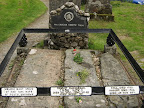
A few miles up the road we stopped at a wool mill to meet Hamish the Highland cow, whom Paul fed and Ellie enjoyed looking at from a slight distance. Then on to Balquidder and Rob Roy's grave. This was in a neat Kirkyard and I was bummed that we missed church here last Sunday. Really cool baptismal font, great little kirk, and neat to see the ancestral stomping grounds.


Next we headed back east of Stirling to Falkirk to see the Falkirk Wheel, a unique lock system for raising/lowering boats from one canal to another. The lock was cool, but might it have been cheaper to dig a canal at a gentle angle?

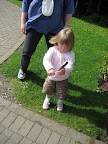
When we disembarked, Ellie said, "Park!" and she was right; there was a large playground past the lock. She walked all the way over there and was disheartened to see that there were no swings. She was willing to accept being pushed while lying on a small rubber hammock in the teen section of the playground, however. She had a great time swinging, climbing steps, crawling through a metal tunnel and backsliding down a slide, and repeating all of it. Then we found a feather on the grass (here's hoping no bird flu!) and she walked all the way back to the vans.


Fun, warm, sun, and a nice treat just for sweet Ellie, who has been amazing this trip. Back to the hotel by 6:00, leftover mac & cheese for Ellie (from lunch) then to bed with her by 6:45. Not quite so for poor, cranky Ada, who preferred everyone to me today and even fussed adorably at me while nursing -

- speaking of which, look who's up -

Thursday, April 26, 2007

Smartypants

It's 2:22 pm and I'm listening to the most beautiful sound in the world.

I'm sitting at my computer in the front room, eating my breakfast cereal. I've been up all day, but after feeding Ada - the morning's first order of business! - and seeing Paul and Ellie off to work and school, I exercised for 45 minutes with Ada in a front carrier. That's the third time this week! Yay me! If I keep this up, I should be able to look in a mirror by the end of summer, and I do intend to look at myself in a mirror again someday soon.

Before I'd had time to sit down or stop sweating, I loaded Ada into the carseat and we headed out to the bank's drive-thru to deposit the last paycheck from Paul's old job. Wahoo! Paul has a new job just 10 minutes from home, no highway driving! With all new people, most of whom have vastly more positive attitudes than those he used to work with. Since his old job was a significant part of our marriage problems, this is especially welcome.

But I digress. When we got back from the bank, I changed and fed Ada, then nursed her again and put her down for a few minutes while I showered. I threw on some clothes and ran outside with wet hair to meet Ellie's bus. She was hungry immediately, so I prepared her lunch (extra cheesy Boca burger) while trying to hold a sleepy/fussy Ada.

When Adelaide started screaming, I sat down to feed her. Confession: I turned on the TV to relax while nursing. Ellie finished eating and curled up on the floor in front of Ellen. 15 minutes later, they were both asleep. I carried Ellie to bed for her nap, but Ada wouldn't be left alone for another hour or so. The two of us laid in my bed until Adelaide was deeply asleep and Ellie woke up.

Currently, Ellie's awake and in the family room watching her daily 22 minute allotment of Dora the Explorer while eating her afternoon snack (yogurt). I have a few minutes to myself, for computer and breakfast. Soon it will be time for games with Ellie, house-straightening, and dinner preparation.

But right now, now is a beautiful moment. The skies have opened with torrents of rain and the sky is suddenly dark. I'm listening to Ellie participating with her television show in the next room. "One, two, three, four, five, six," she's counting aloud.

She's counting aloud. She's counting aloud all on her own. She can count to twenty. And she counts everything, from buckles on the car seat to steps in every staircase we encounter. She is also learning her ABCs, and I'm not doing anything special to teach her, using none of the special Down syndrome learning tools. I've taken to calling Ellie my little smartypants. I mean it in a very positive way, and I'm sure that's obvious from my tone, by her beamingly proud face.

My Ellie might not be the one to discover the cure for cancer, but she is a miracle to me, and she's my amazing, smart little daughter.

Wednesday, February 03, 2010

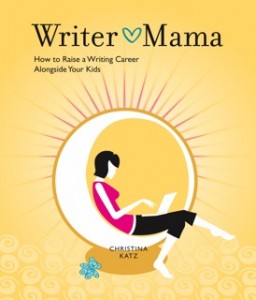
Writer Mama by Christina Katz

This month for Barrie Summy's Book Review Club I'm discussing Writer Mama: How to Raise a Writing Career Alongside Your Kids by Christina Katz.

My sister sent me this book for my birthday last fall, and I was appropriately grateful.  Such a cool-sounding book.  And such a thoughtful gift!  In fact, it's exactly the kind of book I want to have but never get around to reading.

Indeed, this was the case.  For four months, the book gathered dust on my bedside table.  It was on top, right near the front, impossible to miss.  I reached over it to select a new novel from the stack behind.

Then I decided to take the plunge.  I'll review it!  I thought.  I have a deadline!  Now I have to read it, and fast.

In this, too, I failed.  I could not read the book quickly.  But that's because I'm learning so much on every page.  I've always wanted to be a writer.  I've struggled to build a professional identity in the in-between spaces I can scrounge together with very young children at home.  I've wanted to do so much more.  But I didn't know what exactly, and I didn't know how.  Until now.

I was concerned at the beginning of the book, when the author explained how to use a search engine to find things on the internet.  But the pace immediately picked up and soon I knew the difference between "fillers" and "articles," when to query with an idea and when to submit a completed piece, how to take manageable little steps right now to meet long term goals later.

And the truth is that basic stuff is important.  Sure, most people know how to use Google.  And I already know how to read and follow submission guidelines.  But it wasn't so long ago that I didn't know anything about submission guidelines (that they existed, where to find them, what certain code phrases indicate).  Writer Mama makes the industry accessible to a newbie without spending too much time on the basics for the more experienced writer.

The author does a good job addressing moms of kids of all ages, not just napping infants or older, independent players.  And her advice is realistic.  She doesn't recommend plopping kids in front of the TV all morning, but she does acknowledge that a video can be a special treat for a child when her work-at-home mama faces a tight deadline.  She acknowledges - and suggests coping strategies for - the inevitability that some people won't see a writing mama's job as being a "real" job requiring disicpline, professionalism, and regular hours.  And she points out that we're often hardest on ourselves in this regard.

I had a hard time starting this book.  I had a hard time reading as quickly as I wanted to read.  And I had a hard time finishing in time.  (I like to finish a book a few days before I review it to allow time for the sediment to settle in my brain.)  In fact, I didn't finish at all.  But I'm almost done; I'll finish tomorrow.  With this book, I can't skim quickly over the surface of the text; I'm learning something new on almost every page.  I'm highlighting; I'm making notes.

And it's taking a lot of will power to keep reading and learning at a steady pace.  Writer Mama is broken up into 23 chapters, each of which ends with an "Exercise."  Every time I come to an Exercise, I want to stop and do it immediately.  Not yet!  I remind myself, sticking a flag on the page and pushing on, knowing that the minute I read the last page I'll be starting over at the beginning with the first exercise.

And once I've completed the exercises - each of which seems totally manageable, non-overwhelming, fun and exciting, actually - I'll have several pieces written and queries sent off to editors.  I'll be well on my way from wanting to be a professional writer to actually being a professional writer.

This book is teaching me how to do something I've always wanted to do, but never knew if I could do, let alone how to get started, how to build a business, how to make it work.

Motivational.  Educational.  Interesting.  Useful.  And, did I mention, motivational?


Click icon for more
book review blogs
@Barrie Summy